I wanted to share a few stories of patients I have taken
care of while here. These are by no means representative of the people here, or
even necessarily my work here, but rather stories that have touched my heart in
one way or another.
My second day out of quarantine I did my first C-section
here in PNG. The patient’s name was Karen, and she was 30 weeks pregnant with
twins. She had been hospitalized over a week before due to severe preeclampsia
(a condition in pregnancy where the blood pressure goes up, the kidneys spill
protein into the urine). She had been treated with steroids to help her babies
mature faster so that they would be ready for a premature exit and treated for
her high blood pressures, but that day her blood pressures were not responding
to treatment and the team was worried that she might develop seizures or other
serious complications from preeclampsia.
The first twin was in a breech position where the legs and
butt are down instead of the head, so the decision was made to proceed with a C-section.
Not having done a C-Section for about 7 months since the end of residency I was
nervous heading into the surgery. As we prayed for Karen before starting the case,
I tried to take a few deep breaths to steady my hands, and my prayer took on a
greater sincerity. Dr Ben, the general surgeon at the hospital, was my overqualified
assistant and helped me orient to doing surgery here. Thankfully the surgery went
well and both babies were delivered safely.


A few weeks later I returned to work on our OB Ward. To my
delight, I was able to resume care for Karen and her two babies, a boy and a
girl. Over the next several weeks I was able to watch them grow, learn how to
breast feed, no longer require the NG tubes (tubes through the nose into the
stomach used for feeding) or the oxygen. This last weekend they had both made
it past 2kg and were growing well by just breastfeeding. I was able to send
them home. It was a bittersweet departure, joyful at their progress and ability
to go back home but also sadness that I would not be able to see these twins
grow and see Karen’s shy smile every morning.
……
I was convinced that Bill would not survive when I saw his
mother carrying him into the emergency room. She was trying to breathe into his
mouth while carrying him in, a sign that he was not breathing. I rushed over
with the nurse and helped her lay him on a patient bed. Amazingly he still had
a pulse, but he was not taking any breaths on his own. We started using a bag-mask
to help him breathe while the nurse took vital signs and attempted to get an
IV. His mother stated that he had been having bad diarrhea for weeks. After 5
minutes he began to take breaths on his own and after 10 minutes he no longer
needed our support to breathe, just some oxygen. We were unable to get an IV so
I had to place an IO-a needle that goes into the marrow of the bone to allow us
to give fluids.
That night I walked up to the hospital two more times to
check on him, each time a little surprised but also thankful that he was still
alive. That night I prayed, trying to trust Bill to God. In my work here and in
Malawi I have seen many kids die. Sometimes they came in like Bill, malnourished
and dehydrated on the verge of collapse, only to die within a few minutes of
arriving despite our attempts. Others suffering from malaria or trauma or
premature birth would last a little while longer only to succumb to the
overwhelming pathology. But thankfully, by God’s grace, his attentive mother and
the nursing staff, he not only made it through that night but also the next one
and the next one.
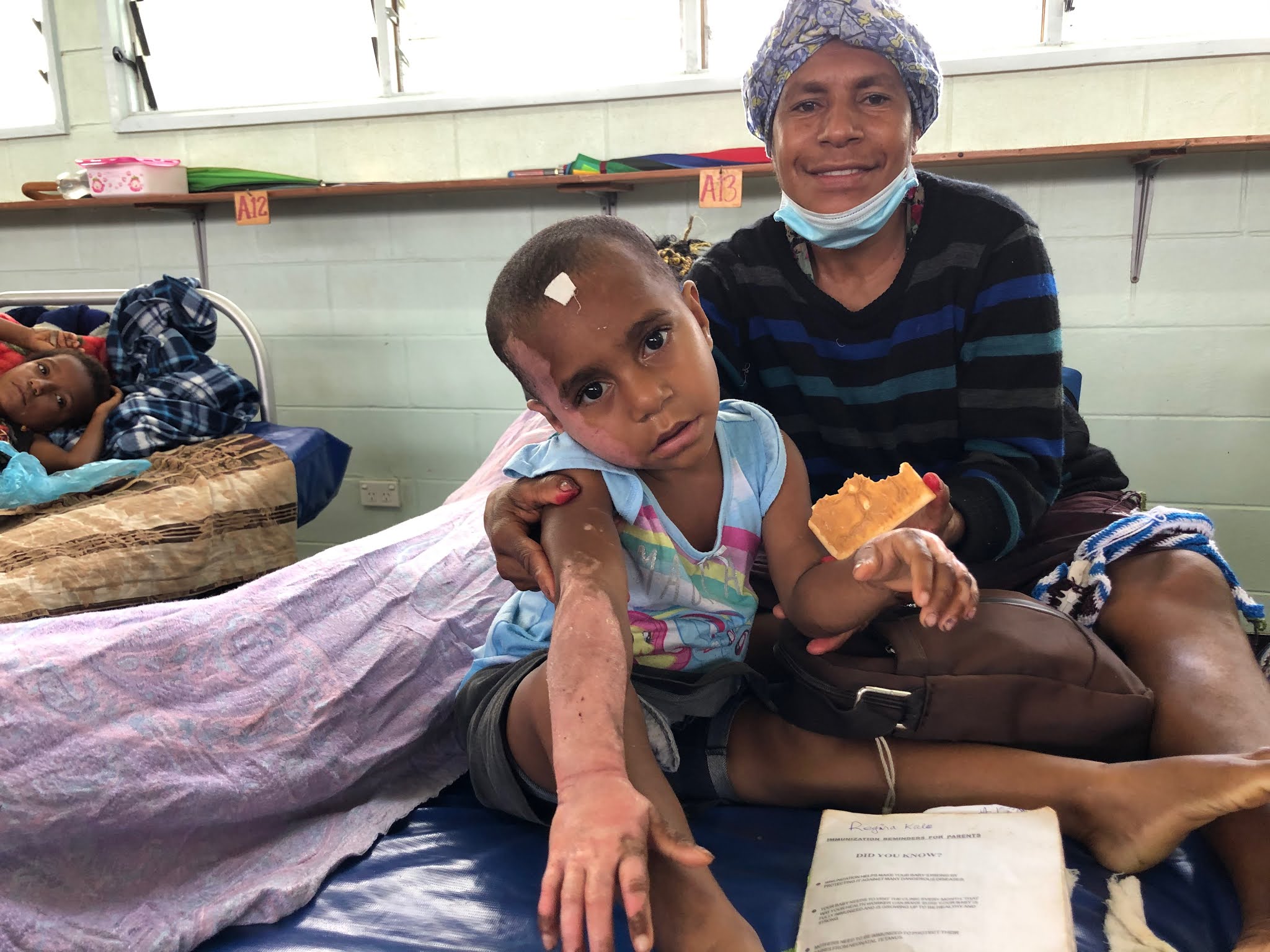
I checked on Bill several times over the next few days,
every time seeing him more alert and interactive. A week after he was brought
in, I took this picture.
Seeing children die can be overwhelming, heartbreaking and
discouraging. But thankfully we are able to make a difference for many. And for
Bill that difference means the world.
….
Rose was brought into our hospital by a helicopter from the
Jimi valley, a large valley north of our hospital, that despite not being a
long distance away (40-60km), can present an often-insurmountable barrier to access
for our patients that live there. With a reliable car, it is a 4-5 hour very
bumpy ride out to our small health outpost in the Jimi Valley. For many of our
patients it can be a trip of several days. Luckily for Rose, she was able to be
brought in by a helicopter for obstructed labor.
Rose had been in labor for 2 days but had not been able to
deliver her infant vaginally. Our hospital is the only health care facility for
our province of 350-400,000 people that has surgical capabilities and can
provide blood products. As such, we see a large number of complicated
obstetrical cases.
We brought Rose back quickly for a C-Section. The baby was
difficult to extract due to the length of her obstructed labor and the moulding
of the head into the pelvis. There was thick meconium (baby poop) that had
obviously been present for some time. Thankfully Dr Ben was available to help
me with the delivery. I scrubbed out of the case to help resuscitate the baby while
Dr Ben started to close the uterus. After about 10 minutes of resuscitation the
baby was crying and breathing on its own.
Over the next few weeks, I have been able to care for Rose and
her baby. Rose initially healed very well; however, she subsequently developed
a wound infection and has required further care and antibiotics in the hospital.
As she is not able to get wound care near her home in the Jimi Valley, we have
kept her here to continue to help her heal in a safe environment. Her baby has
done very well and seems to get bigger every day.
Every morning Rose greets me with a soft, shy smile. She has
been so patient throughout her time here. I am so glad that she was able to
arrive when she did. If she hadn’t and if this hospital weren’t here, both her
and the baby likely would have died.
I hope these stories encourage you as much as they have
encouraged me. Sometimes seeing the health disparities here can be
discouraging, but there are bright lights like Karen, Bill and Rose too that
give me strength to keep working to help the people here. I am so thankful for
the staff here who have been giving of their lives to help this community for years
and years.
I would really appreciate your continued prayers. We are in
the midst of our first large outbreak of Covid in the province and there is a
lot of fear and uncertainty. Many patients are not coming into the hospital due
to this fear and we know that this is probably leading to a number of patients,
especially pregnant women, not receiving critical care. I’d also appreciate prayers
for finding community amidst a pandemic and perseverance as I continue to have
so much to learn, language, culture, tropical medicine and especially learning
to make diagnoses/decisions in the face of uncertainty.
I want to end with a Henri Nouwen quote from a devotion
today, “Learn the discipline of being surprised not by suffering but by joy. As
we grow old…there is suffering ahead of us, immense suffering, a suffering that
will continue to tempt us to think that we have chosen the wrong road…But don’t
be surprised by pain. Be surprised by joy, be surprised by the little flower
that shows its beauty in the midst of a barren desert, and be surprised by the
immense healing power that keeps bursting forth like springs of fresh water
from the depth of our pain.”
You all are in my prayers. I love hearing from you!